Showing posts with label house music. Show all posts

Freedom to Party - March 1990 - Spot Your Face! Video


Most of you have already heard of the Freedom to Party Campaign of the 1990s. My involvement is also public knowledge so i wont go into that here. What's interesting about this post are the many faces that came to the protest. I took a series of shots on that day and wanted to see if anyone recognised themselves from the photos. I've kept it short and sweet, also added an original Genesis'88 pirate radio ad i recorded in 1989…


If your in the shots be sure to comment otherwise like, share etc 


MORE TO COME


UK Acid House - Philadelphia Inquirer - October 1990

A New Wave Of British Invaders?
 London's Music Press Gushes Over The Sensation In Manchester, 
England: Trendy New Working-Class Bands. But Across The
Atlantic, Listeners Are Less Than Taken With The Hype.


Philadelphia Inquirer - 28 Oct 90 - Sunday, October 28, 1990
By Tom Moon, Inquirer Popular-Music Critic

Is the British pop-music scene driven by fads rather than fresh sounds?


It seemed that way this summer, as highly touted bands such as Stone Roses and Happy Mondays, which made their reputations playing the all-night Manchester dance parties known as "raves," attempted to translate their United Kingdom success into a full-fledged invasion of the States. London's weekly music papers Melody Maker and New Musical Express rhapsodized over the bands' singles and covered just about every performance as if it were breaking news. One New Musical Express editor, Danny Kelly, called the Manchester sound "the most important music since punk." The relentless praise was enough to prod even the international edition of Newsweek into action: Its July 23 cover story "Madchester" breathlessly trumpeted a new golden age of British pop. Such enthusiasm was not to be found on this side of the Atlantic, however. Critics who attended dates on Happy Mondays' much-ballyhooed second American tour in July reported that the group "didn't translate" musically.
 

One U.S. recording industry executive said England's talent pool had gone dry: "Artist development has slowed to a halt in the U.K.," said Irving Azoff, president of Giant Records, at July's New Music Seminar in New York. Referring to scouting reports, he hinted that the scene might not merit further investigation, and added, "More listeners seem to be saying, 'If you don't feed our heads, we're going to stop tapping our toes pretty soon.' " As with previous musical "invasions," the Manchester boom owes much to Britain's trend-obsessed youth - and insatiable music press. The scene has been blown out of proportion, its bands hailed as messiahs by journalists eager to lay claim to the next phenomenon. What really was happening in Manchester was exciting enough: fans turning out by the thousands to catch the leading bands or any of a number of up-and- coming attractions. In this industrial town, music remains one of the few ways to avoid a dead-end factory job, or, if you're stuck in one, to forget about it.


Groups from the area have slowly begun to penetrate U.S. consciousness - Stone Roses reached the top of alternative-music charts with "Fool's Gold" last year. But it's too soon to know if the leading Manchester bands - the Roses, Happy Mondays and Inspiral Carpets, whose U.S. debut was released by Elektra last week - are Frankie Goes to Hollywood meteors, or the first examples of a bold regional style that will take over the world the way the Beatles and the Mersey Beat did. "The British music press likes to do that every so often, find these little scenes that they think they discover," said Anthony Boggiano, manager of Inspiral Carpets and its Cow Records label. "By the time they started writing about these (Manchester) bands, they were already releasing singles and playing to 1,000 or 2,000 people a night. They had already been proven, in a sense, and were capable of drawing a crowd."

Boggiano, who this year counseled Inspiral Carpets to turn down the British Broadcasting Corp.'s request to do an animated series based on the irreverently retro group, acknowledges that constant exposure in the United Kingdom helped the Carpets develop a loyal fan base, essential in the cutthroat British pop market. But to make too much of their popularity at home could be fatal overseas. "The hype got over (to America) before the bands got over there," Boggiano said from his office in Manchester. Boggiano says he worries that the Carpets' eponymous debut, an anthology of singles and tracks from British EPs, is likely to suffer from too much preliminary publicity. "People in the U.S. are naturally very distrustful of all that attention. What's more, there's no way a band can live up to those expectations."


The current Manchester bands have plenty of company in pop history books. England's early rock days of the '60s saw the Tottingham Sound, represented by the squeaky clean, mushy Dave Clark Five. In addition to the Beatles, exponents of the Liverpool scene included the Searchers, Gerry and the
Pacemakers and Cilla Black. Birmingham boasted such acts as Spencer Davis and the Moody Blues. And the light and polite pop of the Hollies, Freddie and the Dreamers, and Wayne Fontana and the Mindbenders put Manchester on the map.

During the punk period that began in 1977 and the years that followed, Manchester's Buzzcocks, the Smiths and Joy Division (and its successor, New Order) shared a dour, mopey world view and a penchant for provocation. Punk in Manchester was more than a fashion statement; it was a political stance. As guitarist Johnny Marr of the Smiths told one reporter, "Everybody took it seriously. The punks were singing songs about being unemployed, and in Manchester that really meant something."


Like their musical forebears, Manchester's current bands come from working- class backgrounds and share an affection for '60s psychedelia, modern dance music and Northern Soul (Simply Red is a leading exporter of this Manchester oddity, based on American soul from Memphis to Motown). In this northwest England port city 35 miles east of Liverpool, music and dancing represent the '60s ideal of shared experience. Tom Hingley, 22, lead vocalist for Inspiral Carpets, says Manchester audiences and musicians are receptive to any number of different sounds.


"None of (the region's) bands considered themselves definitive Manchester bands," Hingley said. "We helped the scene by adding some humor to it, and the scene helped us by giving us a shot outside of our home town. But we don't depend on that - the bands rise and fall by the music." The Manchester craze started at the Hacienda, a club opened in 1982 by Factory Records president Tony Wilson, who was responsible for signing New Order. Offering high-energy dance music including acid house and (occasionally) live bands, the club became the site of all-night raves - dances fueled by the drug Ecstasy, an amphetamine variant. "If there is any idea at all (behind the raves)," Wilson told Newsweek, ''it is about community and collective strength. There is democracy in dancing." As they became more popular, the raves spawned a look: bell-bottom pants and baggy shirts of primary colors. They also required more bands to keep the crowds in constant motion. The parties, which have spread throughout Europe, became a proving ground of sorts, a place where bands could test their ability to enchant - and, more important, hold - a crowd.


Most Manchester bands have a danceable, though hardly bubbly, sound that combines the repetition of house music with the smeared guitar-and-organ strains of '60s psychedelia and the cold calculation of techno-pop. Like the physical surroundings, Manchester's music is bleak, dank, industrial. Yet it's also obsessed with a joyous release of tension, and a belief in the power of the dance floor as at least a temporary antidepressant. There are important differences among the bands. Happy Mondays uses drum machines to reinforce downcast, mechanistic themes; its recent single "Kinky Afro" finds the band paraphrasing LaBelle's "Lady Marmalade" as a chorus. Stone Roses concentrates less on dance-pop, more on folk. A Roses sound- alike, the Charlatans UK, brings weighty introspection to its music. And the instrumental outfit 808 State creates mood pieces that contain floating melodies and driving, trance-inducing rhythms. Inspiral Carpets, perhaps the most musically sophisticated of the bunch, engages in outright '60s revivalism on "Move," "Weakness" and other selections from the U.S. debut. Sometimes this retrospection is in the margin; other times - when, say, the band goes unashamedly for a Doors sound - it is impossible to miss.
 

There is even a second wave of Manchester bands, largely a result of corporate attempts to jump on the bandwagon. After Stone Roses became huge in England, one major record company, Phonogram, sent six representatives to Manchester with orders not to return until they had signed a band. The result: a crop of bands such as James and Adamski that are mildly interesting but make the kind of derivative music that needs the hype of a "scene" if it's going to sell.


When the record companies "couldn't get the bands that had been active for years and were ready, they signed anything," said Inspiral Carpet's Boggiano. Boggiano believes that saturation coverage in the British music trades contributed to the labels' feeding frenzy, and Stuart Bailey, who edits the album-review section of New Musical Express, concurs. "The press didn't create it, but probably helped keep things moving," said Bailey. "It's like the Mersey Beat - at the end of the day it's only the Beatles we remember; everything else is an ephemeral thing." Bailey says comprehensive coverage of the Manchester scene has been good for business. "Readership was down through most of the '80s and suddenly it's up again," he said. "We really got caught up in the moody, self-indulgent- artist pose that was part of the '80s, and this is a breath of fresh air."

Police Review Magazine - October 1989

Acid House articles from my personal scrapbook...Follow my Blog or Add me on TWITTER for uptotheminute news from yours truly...


The Grin Factor - Q Magazine 1988

Acid House articles from my personal scrapbook...


ID Magazine March 1988


Kris Needs Acid House Mind Map

I met Kris back in 1999, he'd just completed a book about Ibiza and very unhappy. The crutch of his sadness was the fact that most of the book was dedicated to Kris and his girlfriend of the time. By the time the book cam out they'd unfortunately split up and Kris was on a mission of self destruction. Not to say he hasn't been there before, Kris is actually more like a rockstar than a journalist, everything about him says 'i can stay up for five days and still play the shit out of this guitar, bring in the new girls' Kris has been there seen it and done it... He came to watch me do a book reading and got so pissed beforehand he spent the rest of the night on his back... That said the man knows his music history and at some point created the map you see below... No doubt Kris is happy as ever today...


Wikipedia says...

Kris Needs (born 2 July 1954) is a British journalist and author, primarily known for his writings on the music scene from the 1970s onwards. He became editor of ZigZag Magazine in August 1977, at the relatively young age of 23, and has written biographies of numerous rock and dance stars including Primal Scream, Joe Strummer and Keith Richards.  In the late 1970s he fronted a band 'The Vice Creams',[1] appearing in John Otway's Aylesbury Market Square free concert.  He started in journalism, while living in Aylesbury, Buckinghamshire, with the Thame Gazette, a weekly newspaper in Oxfordshire.  Needs and Wonder Schneider formed the band Secret Knowledge and released the 1992 club hit "Sugar Daddy" on the Sabres of Paradise label. The track also appeared on their 1996 electronic album So Hard on Deconstruction Records; Needs and Schneider wrote all the material, occasionally with artists such as Ashley Beedle and Jah Wobble...


Danny Rampling Interview - Acid House 1989


Soul Underground 1989 - Acid House Article

I remember this article because it was the first time I'd seen the Genesis name in a magazine...


Evening Telegraph - Friday 11th 1989

Due mainly to the tireless efforts of England's national media Acid House events were staged up and down the country. There wasn't a village untouched by the Acid House tsunami...


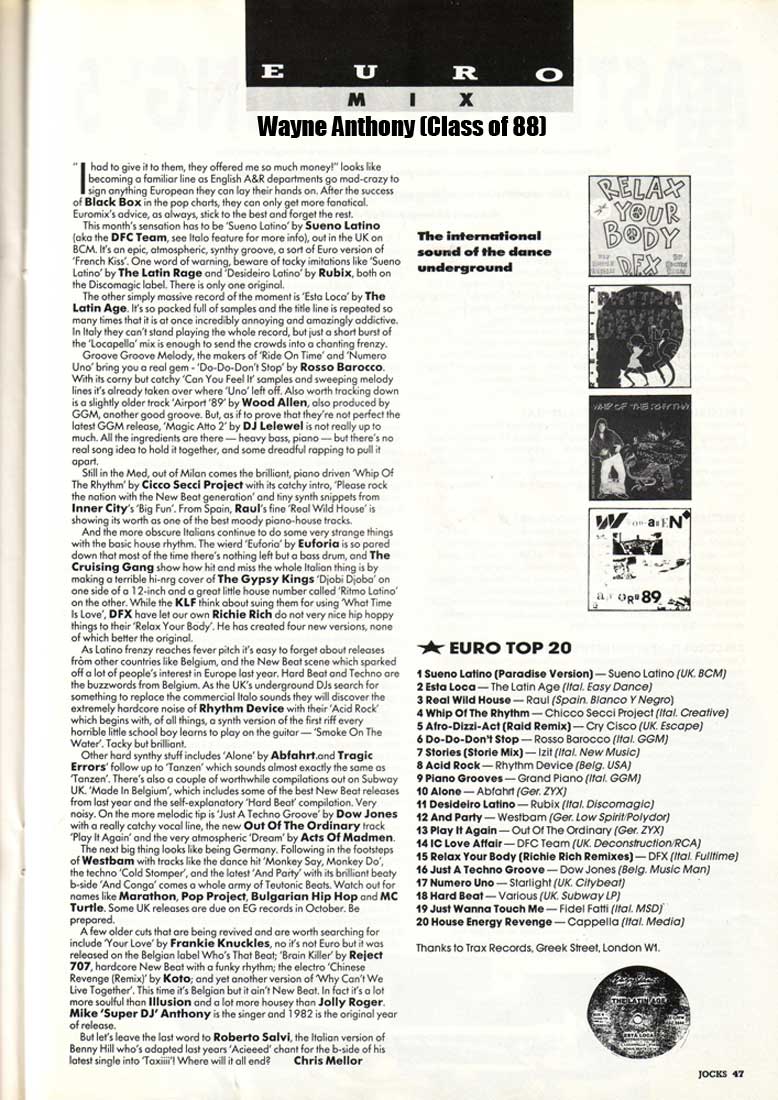
Italian House History - Jocks Magazine 1989


thanks Monica 

Mix-Mag (Acid House) September 1989

Thanks again to Monica for sending me these articles...


Jocks Magazine - September 1989

Jocks (Magazine for DJ's) - Thanks to Monica for sending me this and loads of other related articles...


Class of 88 - Amazon Best Sellers List


In the last few years I've been monitoring secondhand sales of the original Class of 88 paperback book and I'm shocked, delighted and gutted i didn't get a royalty on £450 that was once paid on amazon.com. There's a huge difference in prices between the two sites as sometimes on amazon.co.uk prices can start at £10 and max out at £450. I almost fell over when i saw the £450 but over on amazon.com the standard price for the book is $350.

I should point out that authors don't receive any royalties on secondhand books and i think its great that someone can read my book and actually earn 500 times the cover price. What i find somewhat disturbing is the fact I've sent many of these sellers a private message congratulating them on the fact they get so much money on this title. I'm polite, courteous and gentle with my words but not one of them have ever replied to my message. 


Two American companies in particular are obviously sourcing the copies wherever they can and putting them up for over $300 dollars each time. These companies have been consistent throughout the time I've been paying attention and must have sold easy a dozen copies each. In effect I've made them a few quid and they wont even reply to my message…

When the new Special Edition Class of 88 comes out in shops next year I'll be swapping brand new signed editions for original copies…


I did a little investigating on the book on amazon and found some other facts that Im also quite proud of. Taking into consideration that the book hasn't been in print for eight years I think the stats speak for themselves...


Amazon (July 2012)

Secondhand copies of this title have been on sale for the past seven years and have sold for £25 - £500.

Amazon Best Sellers Rank - Books (overall) Class of 88 144,225
Amazon Best Sellers List - Alcohol & Drug Abuse - Class of 88 N0.72
Amazon Best Sellers List - Drugs - Class of 88 N0.87


LSD Magazine Interviews - Farley Jackmaster Funk (Issue 2)

My LSD Magazine partner and i got to speak to the legends we idolised during the Acid House Revolution...This is an Excerpt from the interview which you can read fully online...


Farley Jackmaster Funk is a living legend, a man who kept pushing the boundaries of the musical experience and the dancefloor. Originator, innovator, ambassador, he is at the core of the house revoloution and a spellbinding influence on other giants of the movement. The man who played such a seminal role in the whole concept of house, the man who broke the UK and opened us up to the whole journey took us on a ride through his memories and insights.


What was the vibe like in the Hot Mix 5 and how did the Hot Mix 5 set the flavor for mid 80’s Chicago?

Incredible. It was actually pretty hard to take in, because you didn’t even realize that you were creating a whole new genre of music and every day was like Christmas. The Hot Mix 5 set the whole tone for everything that happened after us in house music because it was radio, and whatever it was that we did individually in clubs paled next to what we were doing with the radio. I mean we had over 3 million listeners every Friday and every Saturday and as far as the music went, we didn’t really have to break house per se as if there was nothing comparable before, because disco was there and house is an extension of disco, only electronic. For me the beats were the same and it was almost like making electro house in that the house was already there and it was about taking it electronic. But suddenly it had a name and that made it easier to break it as a new style.


And I tell you what, we used to play a lot of Euro stuff and what was coming out of Europe really didn’t get enough credit because some of the music that they were making in the early 80’s was around before we started our style back in Chicago. The same goes for Prelude Records too who were honing their own electronic sound at the beginning of the 80’s, and those guys really didn’t get categorized or credited into the genre until later when people actually started looking back and naming those records house once house had really come into its own.


How big a part did gospel play in the soul of early house? 

Well for one thing, a lot of the singers actually came from church, as they did in disco and almost every other musical style, because people who went to church had grown up learning and honing these amazing vocal skills. The dances too were very reminiscent of being back in church – we used the 2 step and clapped our hands on the dancefloor in the same way that we used to in church. Think about it – house – God’s house – there was a whole lot of stuff that we didn’t really click when we were naming things, because we were just coming up with them out of nowhere, that so many of them were actually parodies of our experiences in church. Think about a pastor who preaches to a congregation – a DJ was basically preaching musically to a club congregation, and even the mirrorball hanging from the ceiling was an almost identical symbol to a cross hanging in the middle of church


How did Aw Shucks go down in the clubs when it first came out? 

Aw Shucks went down beautifully because I had ripped the bassline from a song called Beat the Street by Sharon Reed, so the foundation of the song as already familiar to people and the Aw Shucks of course came from Let No Man Put Asunder. I just took two ideas and put them together, because don’t forget, I wasn’t a musician in the early 80’s so what I would do was to basically remix or reshape other people’s music, set it to the house beat and name it house music! Even the record label I had at that time was called House Records, and everything I was doing was coined or branded house to really identify it and help push the genre.


That’s basically where Love Can’t Turn Around Came from too, taking the deep soul vocals of Issac Hayes and working it into a house groove. Exactly. That was an original composition but in the same way that rappers used to take James Brown’s beats and then rap over them and in fact what the whole essence of dance music was all about – ripping old records, updating them, giving them a new beat and then coining a term for the style like ‘house’. In the early 80’s, a lot of the Brit stuff that came out was generated in the same way, that’s what ‘mash ups’ were. They would take accapellas, because the kind of singers they were looking to use weren’t really around in Britain – it was much more of an American sound, but they would then lay other music under the accapellas and create mash ups. 

Love Cant turn Around was huge in the UK. Was the UK even on your radar before that track had such soaring success? 

All I knew was ‘London Bridge is falling down, falling down, My Fair Lady’ (note from editor – that was the Jackmaster on vocals down the phone!) before Love Can’t Turn Around happened. I was blessed to make that record, blessed to meet people that I would never have thought of meeting and all through the music of the music. That was a total thrill because it was a whole other world for me and everyone else who had the chance to come to England and a really special opportunity for us to get together and learn about each other’s culture. And all through the music. I tell you – still to this day it is awesome. At that time, I was big in England and even more famous in Chicago, and it was an amazing experience to be bi coastal in the States, international, and just travelling all over the place with this new idea, this new style that I was basically representing and promoting. Pretty hard to take it all in actually. So I’m arriving in London and the first thing I want to see for real is the black taxi after watching The Saint and Simon Templar back home. Being a boy, cars were my thing and I was fascinated by the different vehicles, even down to you guys driving on the opposite side of the road. That was the kind of thing that drove us, going back to Chicago and telling these stories and seeing everyone sat there going ‘Get outta here man – you’re full of it’ And then next thing you know, they’re making records too, and they’re getting their own chance to go over there and then come back and spread the word even further. I think house music did wonders for the sightseeing business because you had all these guys heading over from Chicago, just so excited to be sat on a plane off to see a different country and experience another culture...


READ FULL INTERVIEW IN LSD MAGAZINE ISSUE TWO