Showing posts with label class of 88. Show all posts

Wayne Anthony's Acid House Flash Mob 2008

There are not many things in this world i wont have a go at…this is not the time or place to discuss what i wouldn't do…A few years ago (2008) i organised a couple of Acid House Flash Mobs in central London, well actually one was at Liverpool Street Station and the other was in a gallery where an Acid House exhibition was being held. Facebook has many advantages as far as connectivity is concerned but    as far as people clicking I'm Attending on Events Page and them actually coming is few and far between. Both flash mobs had hundreds of people Attending but only a few turned out…We still did it though…

Big Love to those that turned out, Your on my lifetime Guestlist… ;)


THIS IS THE TUNE WE USED


Class of 88 on Kindle, iPad, iPhone, iTouch, Mac, PC

Class of 88 on Kindle


I do love the advancement of technology and am always ready to get stuck into new devices that come onto the market. I'm not a gadget type person i love products with multi-functionality that i can fully utilise in my daily life. These days we carry so many electronic devices that most are opting for all-in-one machines that can do everything but brush your teeth.


Class of 88 on iPad

If when i originally wrote Class of 88 in 1998 i didn't think for a moment that people in the future would be reading my book on cell phones, flat screen pads or devices configured specifically for digital books, i probably wouldn't have believed it at first. Alas here we are, 2011 and though Branson's space travel hasn't quite reached the tourist sector, we appear to be making huge advancements in electronic delivery of digital media.


Class of 88 on iTouch

Although this edition is called The Special Edition it doesn't relate to the fact its available on new platforms, its special because its rewritten with over 100 pages of new content. So it gives me great pleasure to continually remind you of the kindle version (if i don't no-one else will) but also the fact you can read Class of 88 on PCs, Macs, Kindle, iPhone, iTouch, iPad…


Class of 88 on iPhone


I appreciate your continued Support…


The audio of this video is a montage of interviews I've done on BBC, Channel 4, ITV


Acid House on National Geographic (march 2011)


Wayne Anthony (well a photo and our (Andrew Pritchard, Keith B) parties anyway) on National Geographic, cool, ok it wasn't because i discovered an unknown tribe in the thick jungles of Africa or South America and if i were an explorer of this elk then Im sure i'd be disappointed. Yes there were some misleading statements made on the documentary such as the ICF (West Ham football hooligans) were running our security when in fact only three members of the entire security team ever fought for West Ham. They ran their own warehouse parties. Carlton Leach was one such individual who i should also point out, wasn't under the guise of ICF. They were independent hard men from the shady pubs of London's East End who commanded respect from most of their peers. Originally this was orchestrated by another person who shall remain nameless and if not for this person my two partners and i wouldn't have got out without a few stitches. The east end had to be the obvious choice for our security otherwise an outside firm ran the risk of going against a local firm and thats always going to be messy.


As top policeman Kenneth Tappenden points out, bank robberies in London went down to zero at the time of Acid House. Now that shows two things 1. Bank Robbers put down their weapons and got right on one 2. They shifted attention to the loved-up water guzzling promoters of Acid House or 3. All of the Above.

Kenneth Tappenden also says that he wished he had us as his lieutenant and the military couldn't move people as quick as we did. Fairplay to Kenneth as he was head of the Police Pay Party Unit, the very department set up to stop us...  


My partners Andrew, Keith and I were all 22 years old, totally captivated by Acid House and everything it had to offer. This area of our lives was the most depressing  but we did have a choice. Other than one occasion when we were attacked by some doormen, our security NEVER HURT ANYONE AT GENESIS and it should also be noted that this wasn't New Jack City, where teams of armed guards stood over the dancefloor. Our security were very discreet and polite to everyone so no-one had a clue what was happening behind the scenes until my book Class of 88.


UK Acid House - Philadelphia Inquirer - October 1990

A New Wave Of British Invaders?
 London's Music Press Gushes Over The Sensation In Manchester, 
England: Trendy New Working-Class Bands. But Across The
Atlantic, Listeners Are Less Than Taken With The Hype.


Philadelphia Inquirer - 28 Oct 90 - Sunday, October 28, 1990
By Tom Moon, Inquirer Popular-Music Critic

Is the British pop-music scene driven by fads rather than fresh sounds?


It seemed that way this summer, as highly touted bands such as Stone Roses and Happy Mondays, which made their reputations playing the all-night Manchester dance parties known as "raves," attempted to translate their United Kingdom success into a full-fledged invasion of the States. London's weekly music papers Melody Maker and New Musical Express rhapsodized over the bands' singles and covered just about every performance as if it were breaking news. One New Musical Express editor, Danny Kelly, called the Manchester sound "the most important music since punk." The relentless praise was enough to prod even the international edition of Newsweek into action: Its July 23 cover story "Madchester" breathlessly trumpeted a new golden age of British pop. Such enthusiasm was not to be found on this side of the Atlantic, however. Critics who attended dates on Happy Mondays' much-ballyhooed second American tour in July reported that the group "didn't translate" musically.
 

One U.S. recording industry executive said England's talent pool had gone dry: "Artist development has slowed to a halt in the U.K.," said Irving Azoff, president of Giant Records, at July's New Music Seminar in New York. Referring to scouting reports, he hinted that the scene might not merit further investigation, and added, "More listeners seem to be saying, 'If you don't feed our heads, we're going to stop tapping our toes pretty soon.' " As with previous musical "invasions," the Manchester boom owes much to Britain's trend-obsessed youth - and insatiable music press. The scene has been blown out of proportion, its bands hailed as messiahs by journalists eager to lay claim to the next phenomenon. What really was happening in Manchester was exciting enough: fans turning out by the thousands to catch the leading bands or any of a number of up-and- coming attractions. In this industrial town, music remains one of the few ways to avoid a dead-end factory job, or, if you're stuck in one, to forget about it.


Groups from the area have slowly begun to penetrate U.S. consciousness - Stone Roses reached the top of alternative-music charts with "Fool's Gold" last year. But it's too soon to know if the leading Manchester bands - the Roses, Happy Mondays and Inspiral Carpets, whose U.S. debut was released by Elektra last week - are Frankie Goes to Hollywood meteors, or the first examples of a bold regional style that will take over the world the way the Beatles and the Mersey Beat did. "The British music press likes to do that every so often, find these little scenes that they think they discover," said Anthony Boggiano, manager of Inspiral Carpets and its Cow Records label. "By the time they started writing about these (Manchester) bands, they were already releasing singles and playing to 1,000 or 2,000 people a night. They had already been proven, in a sense, and were capable of drawing a crowd."

Boggiano, who this year counseled Inspiral Carpets to turn down the British Broadcasting Corp.'s request to do an animated series based on the irreverently retro group, acknowledges that constant exposure in the United Kingdom helped the Carpets develop a loyal fan base, essential in the cutthroat British pop market. But to make too much of their popularity at home could be fatal overseas. "The hype got over (to America) before the bands got over there," Boggiano said from his office in Manchester. Boggiano says he worries that the Carpets' eponymous debut, an anthology of singles and tracks from British EPs, is likely to suffer from too much preliminary publicity. "People in the U.S. are naturally very distrustful of all that attention. What's more, there's no way a band can live up to those expectations."


The current Manchester bands have plenty of company in pop history books. England's early rock days of the '60s saw the Tottingham Sound, represented by the squeaky clean, mushy Dave Clark Five. In addition to the Beatles, exponents of the Liverpool scene included the Searchers, Gerry and the
Pacemakers and Cilla Black. Birmingham boasted such acts as Spencer Davis and the Moody Blues. And the light and polite pop of the Hollies, Freddie and the Dreamers, and Wayne Fontana and the Mindbenders put Manchester on the map.

During the punk period that began in 1977 and the years that followed, Manchester's Buzzcocks, the Smiths and Joy Division (and its successor, New Order) shared a dour, mopey world view and a penchant for provocation. Punk in Manchester was more than a fashion statement; it was a political stance. As guitarist Johnny Marr of the Smiths told one reporter, "Everybody took it seriously. The punks were singing songs about being unemployed, and in Manchester that really meant something."


Like their musical forebears, Manchester's current bands come from working- class backgrounds and share an affection for '60s psychedelia, modern dance music and Northern Soul (Simply Red is a leading exporter of this Manchester oddity, based on American soul from Memphis to Motown). In this northwest England port city 35 miles east of Liverpool, music and dancing represent the '60s ideal of shared experience. Tom Hingley, 22, lead vocalist for Inspiral Carpets, says Manchester audiences and musicians are receptive to any number of different sounds.


"None of (the region's) bands considered themselves definitive Manchester bands," Hingley said. "We helped the scene by adding some humor to it, and the scene helped us by giving us a shot outside of our home town. But we don't depend on that - the bands rise and fall by the music." The Manchester craze started at the Hacienda, a club opened in 1982 by Factory Records president Tony Wilson, who was responsible for signing New Order. Offering high-energy dance music including acid house and (occasionally) live bands, the club became the site of all-night raves - dances fueled by the drug Ecstasy, an amphetamine variant. "If there is any idea at all (behind the raves)," Wilson told Newsweek, ''it is about community and collective strength. There is democracy in dancing." As they became more popular, the raves spawned a look: bell-bottom pants and baggy shirts of primary colors. They also required more bands to keep the crowds in constant motion. The parties, which have spread throughout Europe, became a proving ground of sorts, a place where bands could test their ability to enchant - and, more important, hold - a crowd.


Most Manchester bands have a danceable, though hardly bubbly, sound that combines the repetition of house music with the smeared guitar-and-organ strains of '60s psychedelia and the cold calculation of techno-pop. Like the physical surroundings, Manchester's music is bleak, dank, industrial. Yet it's also obsessed with a joyous release of tension, and a belief in the power of the dance floor as at least a temporary antidepressant. There are important differences among the bands. Happy Mondays uses drum machines to reinforce downcast, mechanistic themes; its recent single "Kinky Afro" finds the band paraphrasing LaBelle's "Lady Marmalade" as a chorus. Stone Roses concentrates less on dance-pop, more on folk. A Roses sound- alike, the Charlatans UK, brings weighty introspection to its music. And the instrumental outfit 808 State creates mood pieces that contain floating melodies and driving, trance-inducing rhythms. Inspiral Carpets, perhaps the most musically sophisticated of the bunch, engages in outright '60s revivalism on "Move," "Weakness" and other selections from the U.S. debut. Sometimes this retrospection is in the margin; other times - when, say, the band goes unashamedly for a Doors sound - it is impossible to miss.
 

There is even a second wave of Manchester bands, largely a result of corporate attempts to jump on the bandwagon. After Stone Roses became huge in England, one major record company, Phonogram, sent six representatives to Manchester with orders not to return until they had signed a band. The result: a crop of bands such as James and Adamski that are mildly interesting but make the kind of derivative music that needs the hype of a "scene" if it's going to sell.


When the record companies "couldn't get the bands that had been active for years and were ready, they signed anything," said Inspiral Carpet's Boggiano. Boggiano believes that saturation coverage in the British music trades contributed to the labels' feeding frenzy, and Stuart Bailey, who edits the album-review section of New Musical Express, concurs. "The press didn't create it, but probably helped keep things moving," said Bailey. "It's like the Mersey Beat - at the end of the day it's only the Beatles we remember; everything else is an ephemeral thing." Bailey says comprehensive coverage of the Manchester scene has been good for business. "Readership was down through most of the '80s and suddenly it's up again," he said. "We really got caught up in the moody, self-indulgent- artist pose that was part of the '80s, and this is a breath of fresh air."

Police Review Magazine - October 1989

Acid House articles from my personal scrapbook...Follow my Blog or Add me on TWITTER for uptotheminute news from yours truly...


The Grin Factor - Q Magazine 1988

Acid House articles from my personal scrapbook...


ID Magazine March 1988


Kris Needs Acid House Mind Map

I met Kris back in 1999, he'd just completed a book about Ibiza and very unhappy. The crutch of his sadness was the fact that most of the book was dedicated to Kris and his girlfriend of the time. By the time the book cam out they'd unfortunately split up and Kris was on a mission of self destruction. Not to say he hasn't been there before, Kris is actually more like a rockstar than a journalist, everything about him says 'i can stay up for five days and still play the shit out of this guitar, bring in the new girls' Kris has been there seen it and done it... He came to watch me do a book reading and got so pissed beforehand he spent the rest of the night on his back... That said the man knows his music history and at some point created the map you see below... No doubt Kris is happy as ever today...


Wikipedia says...

Kris Needs (born 2 July 1954) is a British journalist and author, primarily known for his writings on the music scene from the 1970s onwards. He became editor of ZigZag Magazine in August 1977, at the relatively young age of 23, and has written biographies of numerous rock and dance stars including Primal Scream, Joe Strummer and Keith Richards.  In the late 1970s he fronted a band 'The Vice Creams',[1] appearing in John Otway's Aylesbury Market Square free concert.  He started in journalism, while living in Aylesbury, Buckinghamshire, with the Thame Gazette, a weekly newspaper in Oxfordshire.  Needs and Wonder Schneider formed the band Secret Knowledge and released the 1992 club hit "Sugar Daddy" on the Sabres of Paradise label. The track also appeared on their 1996 electronic album So Hard on Deconstruction Records; Needs and Schneider wrote all the material, occasionally with artists such as Ashley Beedle and Jah Wobble...


Class of 88 - Amazon Traders

Hey folks, i know i've spoken about secondhand books somewhere else on my blog but this weekend i found one of the most expensive editions yet on Amazon ($437) . I know someone in the UK paid £500 from E-Bay once and this i know because one of my cousins was in a pub and his pal came in with the £500 copy. Cuz called immediately thinking something fishy was going on but it was legit. I don't receive any royalties on the secondhand copies though i do commend the sellers for getting so much cash for a book and not some history book or rare fiction book but my book Class of 88. So Im proud of it really. Many well written books were published on Acid House, most of which can be acquired on Amazon for less than £10. Im not knocking the books, why would i, they mention my name and Genesis. My name is mentioned in no less than 18 books at the last count. Amazing, Im honored... I still find it quite unbelievable as i never written more than two pages since school.  

You know what irritates me though and please tell me that Im wrong...


I've contacted numerous vendors on amazon selling my book to congratulate them on earning some vast sums on my book and I wish them luck, no malice, pure love. You know not one of them has ever answered my message, not one of them, how mad is that? I even found one chap on E-Bay selling the PDF of Class of 88 for £3 when i was giving it away FREE and allowed everyone else to list the download on their sites. E-Bay did move fast and swift though, shut the chap down immediately. I wasnt expecting them to do that but i still couldn't allow him to sell that free PDF.

What's even worse than all that is the fact that selling books on Amazon is more profitable than actually writing books. If you join one of their affiliate programs you could sell my book Class of 88 and receive a commission greater than my royalty for writing it. So yes amazon is great for buying books but in reality there are also hanging writers...


When Class of 88 (updated) is re-released next year I'll be offering anyone with the original book to send back to me and i'll send them a signed updated new edition...

Acid House Flash Mob - Wayne Anthony Interview

We did some random Acid House flash-mobs a couple years ago and was contacted by someone writing a paper on this urban activity. He sent some questions which i answered and thought i'd include them here...


1) In what ways have you been involved in "flashmobbing" or similar public interruptions?

Public interruptions? Its all a matter of wordplay. On the one side they call it public interruptions while on other-side they'd probably call it a matter of necessity. We didn't make the rules nor did we have any involvement in their creation, and so as society goes about its daily routine, some rules stand out as pointless acts of control. After all, Admiralty Law has no place on land or in the domain of human beings. Have i been involved in public interruptions? No. I've facilitated a desire to live outside the construct of regulations, terms and conditions enforced by captains of the high seas. Public interruptions are nothing more than human beings expressing a deep urge to be free.

I was one of the pioneers of Acid House and what was later deemed by the media as the rave scene. So i've been involved in countless acts of random activities. I was also at the very blunt end of governmental disapproval during this period so have much experience in this field. Acid House defines an entire generation of people that stood up for something they believed in. It was against the rules but absolutely necessary for the growth of the country. At times such as that the rules have no bearing on the human condition and something should be done to change it. 


2) What were your reasons for doing so, and to what extent were your objectives achieved? Was it pure entertainment or were there deeper, artistic and philosophical reasons?

First and foremost its completely about entertainment, a break from the norm, an opportunity to do something you wouldn't normally dream of doing. That's what its about random acts of performance conducted by strangers in very public locations. I didn't personally set out to create any form of disruption this has and will always be about the movement of people, ideas and perceptions. This is measured by sheer numbers on the specified day of event and the feedback received byway of the marketing campaign.

3) What was the relevance of the location?

Flashmobbing is mainly about location, the more central the better. People attending still have to get home in a timely fashion. So its important for access to public transport to help get the people on their way. We also want to create maximum impact and where better a place such as Liverpool Street Station.

4) What means of communication did you utilise?

In an age of electronic communication we optimise all forms of viral marketing including real world and online campaigns. We create videos, graphic flyers, online groups / communities, message forums and all new technologies on release.

5) Are your events "interruptive" in that they significantly change a particular urban space for a certain amount of time?

I don't care for the word interruptive as on given day my life is 'interrupted' by things out of my control and that's the point, your dealing with a generation of people that deep down wish to be free in every way possible. So yes we stand in mass on a space allocated to us by sheer proxy of being human. No laws, regulations, terms or conditions apply. 

6) What is your name and occupation, and could you please indicate as to whether you are happy to be named in the paper or if you would prefer to remain anonymous?


I am Freeman, a human being, a pioneer, a spiritual provocateur, a visionary and humanist with deep felt love and conviction for all humans and lifeforms in the universe. I am you, they are us and we are them...

7) Please detail any additional information which you may wish to share: your thoughts, experiences and opinions about flashmobbing and public performance in general.

Wherever you find humans you'll find that urge to breakaway from control. Flashobbing provides an arena for complete strangers to shed their anonymity for a short period of time that allows the burden of distrust to evaporate before your very eyes. We all want to trust, love and be loved. Events of this nature temporarily suspends the preconditioning of humanity allowing for that much needed mass empathy. No matter where in the world you are right now when reading these answers. You too have that desire to break away from what you think you have to do in order to survive on this great planet. Just one memory can last a lifetime. So what do you have planned for tomorrow?  


Its just a ride...Bill Hicks

Danny Rampling Interview - Acid House 1989


Soul Underground 1989 - Acid House Article

I remember this article because it was the first time I'd seen the Genesis name in a magazine...


Evening Telegraph - Friday 11th 1989

Due mainly to the tireless efforts of England's national media Acid House events were staged up and down the country. There wasn't a village untouched by the Acid House tsunami...


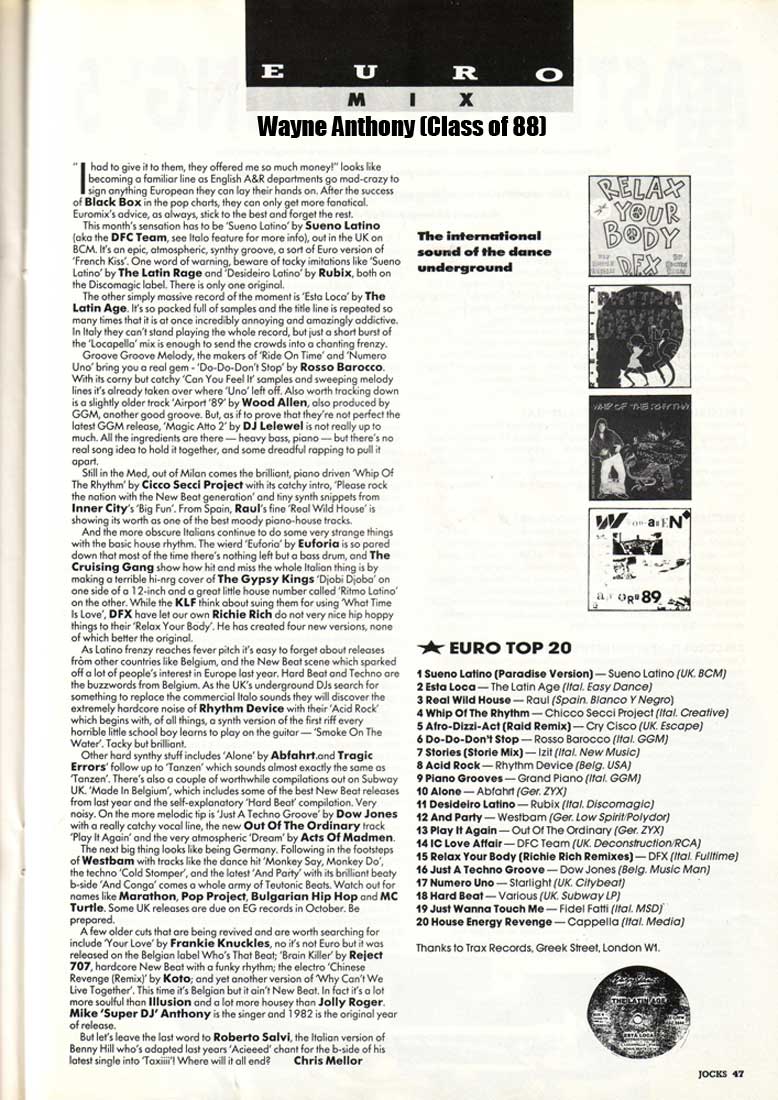
Italian House History - Jocks Magazine 1989


thanks Monica