Showing posts with label House. Show all posts

Mike Pickering & Graeme Park at Hacienda - August 1989 MixTape

Another great download from the ole days... Mike Pickering & Graeme Park at Manchester's Legendary Hacienda Club...


DOWNLOAD HERE http://www.mediafire.com/?as2gqgamagnd7oa


The Track List...
 

1. Gino Latino ‘No Sorry’

2. K-Os ‘Definition of Love’

3. Inner City ‘Do You Love What You Feel’ (Power 41 In Control Remix)
4. Inner City ‘Do You Love What You Feel’ (Power 41 Remix)

5. Royal House ‘Get Funky’

6. Raven Maize ‘Forever Together’

7. White Knight ‘Keep It Movin’ (‘Cause The Crowd Says So)’ (Insane Mix)

8. Sound Factory ‘Cuban Gigolo’

9. Dionne ‘Come Get My Lovin”

10. 28th Street Crew ‘I Need A Rhythm’ (Vocal Club Mix)

11. Adeva ‘Warning’

12. The Bass Boyz ‘Lost In The Bass’ (Mike ‘Hitman’ Wilson Mix)

13. Julian ‘Jumpin’ Perez & Kool Rock Steady ‘Aint We Funky Now’

14. Monie Love ‘Grandpa’s Party’ (Love II Love Mix)

15. Tony Scott ‘That’s How I’m Living’

16. Chubb Rock ‘Ya Bad Chubbs’ (Crib Mix)

17. Akasa ‘One Night in My Life’

18. Kid ‘N’ Play ’2 Hype’ (House Inst.)

19. Kenny ‘Jammin’ Jason & Fast Eddie ‘Can U Dance’

20. Jungle Crew ‘Elektric Dance’

21. NWA ‘Express Yourself’

22. Big Daddy Kane ‘Warm It Up, Kane’

23. Queen Latifah ‘Dance 4 Me’ (Ultimatum Mix – Vocal)

24. MC’s Logik ‘Get Involved’ (In It To Win It Mix)

25. Reese ‘Rock to the Beat’ (Mike Wilsons Hitman Mix)

26. Rhythim is Rhythim ‘Strings of Life’ (Unreleased Remix)

27. R-Tyme ‘R-Theme’

28. Doug Lazy ‘Let it Roll’

29. Frankie Bones ‘We Call It Techno’

30. Seduction ‘You’re My One & Only True Love’ (C & C New York House Mix 1)

31. Sandee ‘Notice Me’

32. Forgemasters ‘Track With No Name’

33. Diskonexion ‘Love Rush’ (Put On Mix)

34. Black Box ‘Ride On Time’

35. Sterling Void ‘Runaway Girl’

36. Annette ‘Dream 17′
37. Phase II ‘Reachin”

38. T-R-P – Let There Be House ‘Untitled’

39. Orange Lemon ‘Dreams of Santa Anna’


40. Shannon ‘Let the Music Play’ (1989 European Remix)
\Film Clip Sample poss from Donna Rouge ‘Sad Song’ 12″\


41. Carly Simon ‘Why’ \ Donna Rouge ‘Sad Song’ (Accapella)
\Martin Luther King “I Have A Dream” Speech Excerpt\


42. Imagination ‘Just An Illusion’ (Park & Pickering Mix)

43. Company 2 ‘Tell it As it Is’

44. Roberta Flack ‘Uh Uh Ooh Ooh Look Out (Here it Comes)’ (Steve ‘Silk’ Hurley Mix)

45. 2 in a Room ‘Somebody in the House Say Yeah’

46. T-R-P – Let There Be House ‘Untitled’

47. Richie Rich ‘Salsa House’

48. Redhead Kingpin & the FBI ‘Do the Right Thing’ (Happiness Remix)

49. Digital Underground ‘Doowutchalike’ (Playhowyalike Mix)

50. Kariya ‘Let Me Love You For Tonight’

51. Nocera ‘Summertime Summertime’ (House ’89)

52. Lil Louis ‘French Kiss’ / Sylvester ‘You Make me Feel (Mighty Real)’ (Acca)

53. 808 State ‘Pacific’

54. Sueno Latino ‘Sueno Latino’

55. Dynamic Duo ‘In The Pocket’ (Hip House Dub)

56. Da Posse ‘It’s My Life’ (Aluh Mix)
57. Technotronic ‘Pump Up the Jam’

58. ?

59. Mix NĂ¢€™ Tel ‘Feel The Beat’ (Pierre’s Mix)

60. Gary Jackmaster Wallace ‘House Has Taken Over Me’ (The House Every Night Oh Yeah Mix)


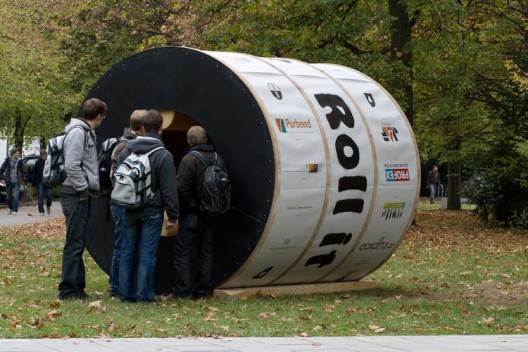
Roll it Experimental Housing University of Karlsruhe


Roll It, a cool experimental house, resulted from the collaboration among different institutes within the University of Karlsruhe.  This cyclindrical design is a modular protype that provides flexible space within a minimum housing unit.  Three different sections are dedicated to different functional needs: there’s a bed and table in section, an exercise cylinder, and a kitchen with a sink.
More images and more about the prototype after the break.

Structurally, the prototype includes an outer shell with the four support rings over a rigid inner shell.  A translucent membrane envelops the entire form and serves as advertising space for sponsors. Thin wooden slats are attached to the membrane to form the running surface of the roll.

The inner cover is a series of laminated OSB panels, each 15 mm thick, that cover the support rings. Circular openings in the side walls allow light into the structure, and a large opening serves as the entrance.


As seen on Detail.

Birmingham Post interviews Wayne Anthony and Others

I was interviewed in a newspaper in Birmingham when my book Class of 88 first came out. The journalist mentioned Biology's party at The Hummingbird which i confessed to attending. The whole event was a bit of a nightmare as the police had practically shout down London to stop Jarvis having his Biology event. Click to Enlarge and Read...

Acid House Parties Against the Lifestyle Police and the Safety Nazis 1991


Acid House Parties Against the Lifestyle Police and the Safety Nazis © 1991 Libertarian Alliance, Paul Staines (MP)

Imagine a regime so totalitarian that it will not allow its young citizens to dance when they want. Imagine that this regime introduced a law which banned dance parties unless they were authorised by the state, and even then the parties would only be allowed to be of limited duration and on state-licensed premises. Naturally this regime would, in line with its ideology, only apply these laws to parties held for profit. The populist pro-government newspapers would of course launch a propaganda campaign against what it would call evil dance party organisers. The pro-government press would conduct a hysterical smear campaign, describing the party organisers as criminals.

In order to combat the subversive profiteering free-market dance party entrepreneurs the state would form Lifestyle Police. Using undercover agents they would infiltrate the parties, discover where they were to take place and then, using helicopters and road-blocks, they would try to prevent the parties going ahead, by turning away thousands of dissident party-goers and arresting the organisers. This is truly a regime of which Stalin or Hitler himself would be proud, implementing socialist policies to protect the citizens from their own moral weakness. If you think this is hyperbole see The Guardian, 3 February, 1990: "Police fear Acid House boom in spring". This reports "a combined intelligence unit drawn from twelve police forces, the Home Office's most powerful computer system, sophisticated radio scanners, monitoring of underground magazines, light aircraft, helicopters, roadblocks and arbitrary arrests." These are surely the hallmarks of a totalitarian state.

 THE LIFESTYLE POLICE AND THE SAFETY NAZIS

Sadly the above is not a fantasy, it is based on reality. In Britain in 1990 all this happened, not under a Communist regime, but under an increasingly authoritarian Conservative government. What the tabloid press called the Acid House Party generated a momentum for yet more restrictions on our civil liberties. This is another example of the Lifestyle Police in action, but the Lifestyle Police are not the police in uniform, they are the conservative, intolerant bigots who demand uniformity. The Lifestyle Police and lifestyle policies are supported by comfortable suburbia and the reactionary readers of the Daily Express. For them different means dangerous. They truly believe that they represent decent values when in fact they have narrow intolerant values.

The Lifestyle Police have infiltrated almost every aspect of our culture. They are the foot soldiers of organisations like the National Viewers and Listeners Association; Mary Whitehouse is the Lifestyle Policewoman par excellence. The Lifestyle Police are controlled by members of a powerful but little known clandestine entryist political party known as the Safety Nazis. They are politically active in the Conservative Party and the Green Party. In America the Safety Nazis' greatest political success was the Prohibition Act. Only the valiant actions of the Mafia managed to save America by machine gunning leading Safety Nazis.

Safety Nazis want to ban things: video nasties, cigarettes, drink, drugs, loud music, pornography, toy guns, real guns, artificial additives, swear words on TV, fast cars, unusual sexual practices, dancing around Stonehenge on the solstice and Acid House parties. They also make you do things for your own good, like wear a seat belt and watch public information films. Overt Safety Nazis are active in the Royal Society for the Prevention of Accidents, the Health and Safety Executive, the Health Education Authority, Alcohol Concern and Action on Smoking and Health.


Safety Nazis have a secret greeting: Sieg Health. Their ultimate totalitarian objective is to take over the world and make it a nice, safe place. The difference between the Lifestyle Police and the Safety Nazis is one of degree. Safety Nazis are politically motivated. They are consciously in favour of safety, despite the ramifications for freedom of choice and individual liberty. Safety Nazis positively enjoy food scares. They go out of their way to deliberately protect the public, they think up laws and regulations, they smile a lot, they care and they are boring. Extremely boring.

The Lifestyle Police are everywhere. Your grandmother could be one. They mean well. They have proper jobs. They are normal. They exert a subtle pressure on their peers and offspring. They think it's disgusting, even though they do not think very hard. They are decent upstanding members of the community. Their methods are so subtle that even they themselves do not realise that they are Lifestyle Policemen. They are unwitting collaborators with the Safety Nazis. 

WHAT AN ACID HOUSE PARTY IS

The Lifestyle Police and their allies the Safety Nazis do not like people enjoying themselves. Why else would they introduce a law to stop people dancing all night? Graham Bright MP introduced a private members bill, The Entertainments (Increased Penalties) Bill, to prohibit Acid House parties. The penalty for having a good time is six months in prison and unlimited fines. Since I derived a great deal of pleasure and a substantial proportion of my income from these parties I want to use the example of Acid House parties to illustrate the anti-libertarian nature of the Lifestyle Police. Before going any further it would be wise to explain what an Acid House party is, since I assume that the majority of people reading this have not attended such a party.

The origin of the term Acid House is the subject of some debate. It was claimed in the debate in the House of Commons, as well as endless articles in the music press, that contrary to popular belief Acid House Parties did not derive their name from the colloquial term for the hallucinogenic drug LSD. The term acid, it was claimed, comes from the streets of Chicago, where it is a slang word meaning to steal, and acid music takes its name from the fact that an acid music track will include samples of music stolen from other recordings and then mixed in to form an end product. Since this particular musical style grew out of the Chicago House sound it was christened Acid House. That at least is what it says in Hansard and you can't get much more official than that can you?

I know this to be completely untrue because I made up this explanation at a press conference held to launch the Freedom to Party Campaign at the Conservative Party conference in October 1989. I was attempting to desperately play down the drug aspect in a forlorn attempt to discourage anti-party legislation, reasoning that the British public might accept massive noisy parties, but thousands of teenagers on drugs were definitely not acceptable. (This, incidentally, is the most successful lie I have ever told. Japanese music journalists have solemnly repeated it to me in the course of interviews and from MTV to ITN it has been broadcast as a fact. Only once was I caught out, when at a seminar held at the DMC World Disc Jockey Mixing Championships, a DJ from Chicago stood up and told the 1,000 or so people in the hall that I was talkin' a complete load of fuckin' bullshit - which I was. This proves that if you tell a lie often enough people will believe it - except when they know it's complete bullshit.) Despite my best efforts the Safety Nazis simply changed their reasons for wanting to ban the parties. They wanted them banned not because they were party pooping killjoys, worried about drugs, but because they were concerned about the physical safety of party-goers at unlicensed venues!

The Safety Nazis outwitted my best lie by changing their tactics.

The parties got their name from the widespread use of the drug LSD (acid) at the parties in the early days. The whole scene revolved around drugs, anybody who knows anything about it will tell you this, unless you are a journalist or a policeman. A plentiful supply of drugs is sure to make the party kick - LSD, MDMA, cocaine, cannabis - the more the merrier. Combine this with pulsating music played at 80 plus beats per minute, thousands of young people dancing wildly, more lasers than the Strategic Defence Initiative, a 50,000 watt sound system and special effects that would make Steven Spielberg proud and you have a truly superior form of entertainment. It might not be to your taste, but for those of us who do like that kind of thing, it is unbeatable. The fact that we had to beat police roadblocks to get in made it even better, since forbidden fruit tastes sweeter.
 

BRITAIN'S PURITANICAL LICENSING LAWS

Britain's archaic licensing laws demand that public entertainments such as nightclubs must be licensed, not just for fire and safety as one might reasonably expect Safety Nazis to demand, but also to serve drink, to play music and to allow dancing. Why do you need a licence? Because the Safety Nazis want to make sure that you're safe! Why do the licences only let you dance till a certain hour? Ask the Safety Nazis. Licences allow music and dancing only until a certain hour, usually 3.30am in London. Few nightclubs in London are licensed beyond that hour. In effect there is a state enforced curfew, strictly monitored by the Lifestyle Police. Break the curfew and you lose your licence, putting you out of business. The whole situation is crazy and without any logic. I have been to nightclubs in pre-perestroika Moscow that were open all hours. I know of nowhere else in the world - except Ireland - that has more restrictive licensing laws, and in Ireland nobody pays the law any attention. If ever there was an area crying out for Thatcherite deregulation it's the archaic system for the licensing of music and dancing.

HEDONISTIC RESISTANCE

Fortunately over the years illicit underground warehouse parties have developed to cater for those people who quite reasonably like to party all night despite the law. People would set up a sound system in an empty warehouse and hold a party. If you were in the know you could turn up, pay cash at the door, and party till the next day in the company of a few hundred other party-goers. Drinks would be sold off the back of a van from crates. A little rough and ready, but fun. Then in late 1987 and early 1988 a new style of music became popular in Ibiza, the sunny holiday hideaway isle for London's avant garde. The music was energetic and people liked to dance to it all night under the influence of a new designer-drug called Ecstasy. The loose Ibiza lifestyle encouraged parties that lasted for days, and if you were reasonably fit, took the right drugs and refrained from alcohol, you could dance around the clock. Ibiza, you will understand, does not have licensing laws or Life-style Police.

When the holiday was over, so was the party. Some of the more enterprising party people decided that they could recreate the atmosphere by holding warehouse parties. As London's party culture absorbed Ecstasy, the demand for underground warehouse parties grew, hundreds of people wanted to do the new wonder drug and dance all night. If you could not get any Ecstasy then some old fashioned acid would do. Amongst the enthusiastic crowd who went to the parties was a young man called Tony Colston-Hayter. An imaginative, entrepreneurial technocrat with a relaxed attitude to legal formalities, he revolutionised the scene. He thought big. Instead of using dark, dodgy warehouses in London's docklands catering for a few hundred party-goers, why not organise parties for thousands of people in bigger venues?

How he did it provides a fine illustration of free enterprise's ability to innovate by taking advantage of technological developments. The parties were attracting the attention of the police, who would raid them and close them down as soon as they found out the location, unless the party was already in full swing, in which case they just turned people away rather than precipitate a riot. Colston-Hayter reasoned that if he could get the people to the location in large numbers before the police arrived, the party would be unstoppable. He made use of a system called TVAR - Telephone Venue Address Releasing. The system worked as follows. During the day a production team would set up the venue, which could be a large warehouse or even an aircraft hangar. In total secrecy generators, sound systems, lighting, lasers, crash barriers, fire extinguishers, portaloos, merchandising stalls, food stands, soft drink stands and even a first aid room would be set up.

At a given time Colston-Hayter would use his cell phone to call a computer which would digitally record his spoken directions to a meeting point, usually somewhere on the M25 orbital motorway which circles London. The computerised system was linked to hundreds of phone lines. The phone number would be printed on the tickets, and at a given hour would be party-goers (and the police) would phone that number and within minutes thousands of callers from all over the South East of England would be in their cars and on the way to the meeting point. At the meeting point accomplices with cell phones would report back to him. Once a critical mass had been reached, and this might be as many as a thousand cars, he would record a new message giving the venue location. The sheer weight of numbers would render the police unable to stop the convoy of freedom loving party-goers heading for the party. The profits on a party attended by over 10,000 people could be up to £50,000. The total turnover could easily be in the region of £250,000 - fines for licensing offences were a maximum of £2,000.


LIFESTYLE POLICE BRUTALITY

The police and the authorities became tired of being outwitted and resorted to roadblocks, bugging phones, harassing organisers and mass detentions - at one party 836 people - only 12 of whom were charged - were detained overnight at 30 police stations. The tabloid newspapers waged an hysterical scare campaign, branding party organisers as evil drug pushers who were poisoning Britain's youth. A special police unit was set up to deal with the parties and undercover police were used. The police pressurised the phone companies into preventing organisers using the TVAR system. Pirate (i.e. free market) radio stations which broadcast party location information were raided and shut down.

Civil liberties were crushed in order to stop young people committing the heinous crime of dancing all night without a licence. If that was not enough a draconian new law was introduced in July 1990 which meant that party organisers could face up to six months in prison and confiscation of all profits. It was at this point that I decided to get out of the business.

The Safety Nazis advanced another step on their long march.

Late last year Dr. Timothy Leary, the guru of psychedelia, was refused entry into Britain. He was due to speak about his ideas [on 'Virtual Reality' computer software] to willing audiences. The Home Office refused him entry, but where were the human rights activists protesting about restrictions on freedom of speech? If a NORAID fund-raiser for the IRA had been refused entry, endless left-wing Labour MPs would have protested. If a bloodthirsty, CIA-backed African guerilla leader intent on publicising his anti-Marxist struggle had been refused entry, every Conservative MP who has been on a free trip to South Africa would be up in arms. Timothy Leary is an interesting man with interesting ideas, yet I am not allowed to hear what he has to say.  The Lifestyle Police strike again.


SELF LIBERATION AND UPTIGHT CONSERVATIVES

I have fond memories of taking LSD and pure MDMA, trance-dancing and thinking that I had turned into a psychedelic, orgiastic wisp of smoke - it was the most staggeringly enjoyable, mind-warping experience I have ever had. The sense of self liberation was awesome and is to be recommended. The only word to describe it is WOW!

Acid House parties represented the perfect environment for drug taking, they provided a marvellous market place for drug distributors and consumers. The chances of being arrested were minimal because of the massive number of people. The atmosphere allows you to enjoy your trip in conducive surroundings, safe in the knowledge that thousands of others are doing the same. The feeling that it is a shared experience is very powerful, people are friendly. If you should bump into someone Eeed Up on Ecstasy they will just smile, you will say sorry, they'll say it's okay, you'll smile and dance off - in a bar even the most minor collision is likely to result in an unpleasant exchange of words, if not a fist fight. Alcohol leads to aggression, MDMA encourages tolerance.

A lot of my Thatcherite/Libertarian friends get very suspicious when I tell them about the love and peace aspects of taking Ecstasy. To them love and peace equals hippies equals leftist. The feeling of unity and shared enjoyment to them smacks of collectivism, not the rugged individualism that they favour. But the drug actually removes inhibitions, liberating your mind from petty concerns. You feel a sense of solidarity, but it is totally voluntary, there is no coercion. Libertarians are opposed to coercive collectivism, but if I as an individual choose to enjoy a collective experience because I want to, than that is up to me. I suspect that a lot of right-wingers, Conservative, Thatcherite or Libertarian, cling to their inhibitions and are actually afraid of letting go. Many Conservatives by their very nature fear the dynamic. They are wary of the unusual and prefer tradition, stability and the conventional. The idea of losing their inhibitions to the extent that they might say or do something embarrassing horrifies them.

Some people, particularly those of a Conservative inclination, have an irrational dislike of drugs, often based on what they believe or know about drug addicts. Somehow drug pushers are evil, akin to poisoners. A lot of drug pushers are unpleasant, but that is because it's an illegal business, and criminals are often unpleasant, violent people. Some drug dealers I know are ruthless, dishonest, dangerous psychopaths, while others are honest, peace loving, fair minded people who just happen to be in a business of which the majority of people are said to disapprove. If alcohol or tobacco was made illegal a similar situation would arise with them. Most British Conservative groups are not at all sympathetic towards legalising drugs, the Committee for a Free Britain being the only one that has come down in favour of decriminalising drugs. This might have something to do with the fact that during my time at the Committee for a Free Britain we got through quite a lot of the stuff. Yet uptight Conservatives are probably the people who would benefit most from taking drugs, particularly Thatcherites, with their machine-like obsession with efficiency and abstract attachment to the freedom to make money. I'm as much of a believer in Capitalism as the most earnest of Young Conservatives, but couldn't we put acid in the punch at the YC ball and then really have a party?

A New Wave Of British Invaders? Philadelphia Inquirer Oct 1990


A New Wave Of British Invaders?
London's Music Press Gushes Over The Sensation In Manchester,
England: Trendy New Working-Class Bands. But Across The
Atlantic, Listeners Are Less Than Taken With The Hype.

Sunday, October 28, 1990

By Tom Moon, Inquirer Popular-Music Critic


Is the British pop-music scene driven by fads rather than fresh sounds?

It seemed that way this summer, as highly touted bands such as Stone Roses and Happy Mondays, which made their reputations playing the all-night Manchester dance parties known as "raves," attempted to translate their United Kingdom success into a full-fledged invasion of the States. London's weekly music papers Melody Maker and New Musical Express rhapsodized over the bands' singles and covered just about every performance as if it were breaking news. One New Musical Express editor, Danny Kelly, called the Manchester sound "the most important music since punk." The relentless praise was enough to prod even the international edition of Newsweek into action: Its July 23 cover story "Madchester" breathlessly trumpeted a new golden age of British pop. Such enthusiasm was not to be found on this side of the Atlantic, however. Critics who attended dates on Happy Mondays' much-ballyhooed second American tour in July reported that the group "didn't translate" musically.

One U.S. recording industry executive said England's talent pool had gone dry: "Artist development has slowed to a halt in the U.K.," said Irving Azoff, president of Giant Records, at July's New Music Seminar in New York. Referring to scouting reports, he hinted that the scene might not merit further investigation, and added, "More listeners seem to be saying, 'If you don't feed our heads, we're going to stop tapping our toes pretty soon.' "

As with previous musical "invasions," the Manchester boom owes much to Britain's trend-obsessed youth - and insatiable music press. The scene has been blown out of proportion, its bands hailed as messiahs by journalists eager to lay claim to the next phenomenon.

What really was happening in Manchester was exciting enough: fans turning out by the thousands to catch the leading bands or any of a number of up-and- coming attractions. In this industrial town, music remains one of the few ways to avoid a dead-end factory job, or, if you're stuck in one, to forget about it.

Groups from the area have slowly begun to penetrate U.S. consciousness - Stone Roses reached the top of alternative-music charts with "Fool's Gold" last year. But it's too soon to know if the leading Manchester bands - the Roses, Happy Mondays and Inspiral Carpets, whose U.S. debut was released by Elektra last week - are Frankie Goes to Hollywood meteors, or the first examples of a bold regional style that will take over the world the way the Beatles and the Mersey Beat did.

"The British music press likes to do that every so often, find these little scenes that they think they discover," said Anthony Boggiano, manager of Inspiral Carpets and its Cow Records label. "By the time they started writing about these (Manchester) bands, they were already releasing singles and playing to 1,000 or 2,000 people a night. They had already been proven, in a sense, and were capable of drawing a crowd."

Boggiano, who this year counseled Inspiral Carpets to turn down the British Broadcasting Corp.'s request to do an animated series based on the irreverently retro group, acknowledges that constant exposure in the United Kingdom helped the Carpets develop a loyal fan base, essential in the cutthroat British pop market. But to make too much of their popularity at home could be fatal overseas. "The hype got over (to America) before the bands got over there," Boggiano said from his office in Manchester. Boggiano says he worries that the Carpets' eponymous debut, an anthology of singles and tracks from British EPs, is likely to suffer from too much preliminary publicity. "People in the U.S. are naturally very distrustful of all that attention. What's more, there's no way a band can live up to those expectations."

The current Manchester bands have plenty of company in pop history books. England's early rock days of the '60s saw the Tottingham Sound, represented by the squeaky clean, mushy Dave Clark Five. In addition to the Beatles, exponents of the Liverpool scene included the Searchers, Gerry and the
Pacemakers and Cilla Black. Birmingham boasted such acts as Spencer Davis and the Moody Blues. And the light and polite pop of the Hollies, Freddie and the Dreamers, and Wayne Fontana and the Mindbenders put Manchester on the map.

During the punk period that began in 1977 and the years that followed, Manchester's Buzzcocks, the Smiths and Joy Division (and its successor, New Order) shared a dour, mopey world view and a penchant for provocation. Punk in Manchester was more than a fashion statement; it was a political stance. As guitarist Johnny Marr of the Smiths told one reporter, "Everybody took it seriously. The punks were singing songs about being unemployed, and in Manchester that really meant something."

 Like their musical forebears, Manchester's current bands come from working- class backgrounds and share an affection for '60s psychedelia, modern dance music and Northern Soul (Simply Red is a leading exporter of this Manchester oddity, based on American soul from Memphis to Motown).
In this northwest England port city 35 miles east of Liverpool, music and dancing represent the '60s ideal of shared experience. Tom Hingley, 22, lead vocalist for Inspiral Carpets, says Manchester audiences and musicians are receptive to any number of different sounds.

"None of (the region's) bands considered themselves definitive Manchester bands," Hingley said. "We helped the scene by adding some humor to it, and the scene helped us by giving us a shot outside of our home town. But we don't depend on that - the bands rise and fall by the music."

The Manchester craze started at the Hacienda, a club opened in 1982 by Factory Records president Tony Wilson, who was responsible for signing New Order. Offering high-energy dance music including acid house and (occasionally) live bands, the club became the site of all-night raves - dances fueled by the drug Ecstasy, an amphetamine variant. "If there is any idea at all (behind the raves)," Wilson told Newsweek, ''it is about community and collective strength. There is democracy in dancing."

As they became more popular, the raves spawned a look: bell-bottom pants and baggy shirts of primary colors. They also required more bands to keep the crowds in constant motion. The parties, which have spread throughout Europe, became a proving ground of sorts, a place where bands could test their ability to enchant - and, more important, hold - a crowd.

Most Manchester bands have a danceable, though hardly bubbly, sound that combines the repetition of house music with the smeared guitar-and-organ strains of '60s psychedelia and the cold calculation of techno-pop. Like the physical surroundings, Manchester's music is bleak, dank, industrial. Yet it's also obsessed with a joyous release of tension, and a belief in the power of the dance floor as at least a temporary antidepressant.

There are important differences among the bands. Happy Mondays uses drum machines to reinforce downcast, mechanistic themes; its recent single "Kinky Afro" finds the band paraphrasing LaBelle's "Lady Marmalade" as a chorus. Stone Roses concentrates less on dance-pop, more on folk. A Roses sound- alike, the Charlatans UK, brings weighty introspection to its music. And the instrumental outfit 808 State creates mood pieces that contain floating melodies and driving, trance-inducing rhythms.
Inspiral Carpets, perhaps the most musically sophisticated of the bunch, engages in outright '60s revivalism on "Move," "Weakness" and other selections from the U.S. debut. Sometimes this retrospection is in the margin; other times - when, say, the band goes unashamedly for a Doors sound - it is impossible to miss.

There is even a second wave of Manchester bands, largely a result of corporate attempts to jump on the bandwagon. After Stone Roses became huge in England, one major record company, Phonogram, sent six representatives to Manchester with orders not to return until they had signed a band. The result: a crop of bands such as James and Adamski that are mildly interesting but make the kind of derivative music that needs the hype of a "scene" if it's going to sell.

When the record companies "couldn't get the bands that had been active for years and were ready, they signed anything," said Inspiral Carpet's Boggiano. Boggiano believes that saturation coverage in the British music trades contributed to the labels' feeding frenzy, and Stuart Bailey, who edits the album-review section of New Musical Express, concurs."The press didn't create it, but probably helped keep things moving," said Bailey. "It's like the Mersey Beat - at the end of the day it's only the Beatles we remember; everything else is an ephemeral thing."Bailey says comprehensive coverage of the Manchester scene has been good for business. "Readership was down through most of the '80s and suddenly it's up again," he said. "We really got caught up in the moody, self-indulgent- artist pose that was part of the '80s, and this is a breath of fresh air."

Chicago Flyers 1980s - House Music Collectors PT 2

Acid House Music Video's 101

 Nitzer Ebb - Join In The Chant (Live 1989)


A Split Second - Flesh (1987)

Mory Kante - Yeke Yeke


Technotronic - Pump Up The Jam [1989] 

Tyree Cooper - Turn Up The Bass (1989) 


 SUBSCRIBE TO MY CHANNEL

Freedom 2 Party - A Ravers Perspective (Fusion)


I was sent this short story some years ago (2001) and personally replied to the email...As Follows;

1 of many memories 1990 - Author: Fusion aka Leigh Kilby

It's Saturday 27th January 1990 8.00am driving up the A2 from Kent going to the Freedom to Party Rally @ Trafalgar Sq arrive and park in Soho Sq walk down Tottenham Court Road and were here,
cannot believe the amount of people we recognise from all the raves we had been to by this time Trafalgar Sq is closed off to traffic the West End is @ a stand still and the police are being funny as usual saying no amplified sound with a beat to come from any of the pa systems then you got Anton giving it his all on the megaphone and then if the buzz wasn't big enough Debbie Malone sings
accapella of Rescue Me.

It's about 6pm now and the rumors are flying around about all the raves in the capital so we hang around for another few hours and try to get in the Astoria but cant get in because the place is full
so we thought ahh lets get up to South Mimms Services see what's happening up there. So off we set up the A1 get to South Mimms and the place is going mental with ravers and that's it someone mentions a rave in Watford so now there's at least 100 cars making there way up the M25 all following the cars in front. I remember a roundabout and turning left under a bridge and everyone's parking up really buzzing.  Now we're all looking at each other saying this is it we can hear it and it's still about a mile down road.

The road is solid with people walking towards it and the music getting louder.  Police everywhere but the rave is going on but they wont let us through. Then all the taunting started and that was it fighting with police and theres this geezer with a shopping trolley full of cans of coke. He's selling them for 50p to throw at police or a pound to drink it, i'd never heard anything so funny as that bloke when he came out with that comment. After all that we never got in but hey theres next week to look forward too, ended up back in London @ Dungeons on the Lea Bridge Road but what a top day that was.

This is what happened! - Wayne Anthony

Hey Fusion!

Wow! I remember that day well my friend. I was one of the organisers and i helped crash the party in Watford later that evening. I took lots of photos at both the demo's (Trafalgar Sq & Hyde Park Corner) Anyway! We held a meeting straight after the demo, (included - Genesis, Sunrise, World Party, Biology, Weekend World), we knew we would stage an event, but didn't have a venue. We
each went off to different parts of London, Slough, Watford. Tarquin from Weekend World found a venue in Radlett. We immediately dispatched our sound and lighting teams. We had a series of recorded telephone lines at the ready for venue details and meeting points which pirate radio stations were waiting to broadcast.

Tarquin greeted us when we arrived at the venue and told us the chap who hired us the fair ground attractions had pulled a shotgun on him and wanted £500 or he would leave. He got his money! People were already arriving at the venue but the sound system hadn't been wired up yet. So i convinced my cousin Bobby to drive his BMW into the building and play music on his £2,000 car stereo. So he did and everyone danced around the vehicle until the sound system was ready to go. By now there was around four hundred people in building and then the police arrived.

Wearing full riot gear and carrying video camera's and bright lights, they'd tried to storm the building. Everyone stood their ground and rushed towards the police. They stopped their charge and we all began chanting Acceeeedd - Acceeeeeed - Acceeeeeedddd

From the position we were standing we couldn't see what was happening around one corner of the warehouse. We heard cheers and then suddenly a thousand or so people came charging around towards. The police tried stopping them, so we all ran outside and into the riot police. For about twenty minutes, we played cat and mouse type games until the police finally gave up.

A lot more happen that night, you'll have to read the book, for the full story.

Wayne Anthony

Acid House on YouTube 101

Nicky Dungeons - Lets Go Back !! Acid House (i was there)


This is Acid House 1988 (i was there)


 Acid House Rave 89 chandal (i was there)

 Sunrise Party 1989 (i was there)

Dance 89 , Energy Party (near Colchester) (i was there)

Roland TB-303 Bass Line


This tiny machine changed the face of dance music forever and to think it wasn't even invented for dance music…Here's the original blurp...


The Roland TB-303 Bass Line is a synthesizer  with built-in sequencer manufactured by the Roland corporation from 1982 to 1984 that had a defining role in the development of contemporary electronic music.  The TB-303 (named for "Transistorized Bass") was originally marketed to guitarists for bass accompaniment while practising alone. Production lasted approximately 18 months, resulting in only 10,000 units. It was not until the mid- to late-1980s that DJs and electronic musicians in Chicago found a use for the machine in the context of the newly developing house music genre.  In the early 90's, as new Acid styles emerged, the TB-303 was often overdriven, producing a harsher sound. Examples of this technique include Hardfloor's 1992 EP "Acperience", and Interlect 3000's 1993 EP "Volcano".  The well-known "acid" sound is typically produced by playing a repeating note pattern on the TB-303, while altering the filter's cutoff frequency, resonance, and envelope modulation. The TB-303's accent control modifies a note's volume, filter resonance, and envelope modulation, allowing further variations in timbre. A distortion effect, either by using a guitar effects pedal or overdriving the input of an audio mixer, is commonly used to give the TB-303 a denser, noisier timbre—as the resulting sound is much richer in harmonics.  The head designer of the TB-303, Tadao Kikumoto, was also responsible for leading design of the TR-909 drum machine.


 http://en.wikipedia.org/wiki/Roland_TB-303

Pump up the Volume - Documentary - Watch Now


Pump Up the Volume tells the story of the social and cultural explosion that was House. From its roots in Chicago, where it rose from the ashes of Disco, House music became the soundtrack to every fashion show, after–show party, premiere, and club opening around the world. Today, House is used by leading mainstream music stars, from Madonna to U2, to break into new markets and to update their sound. In fact, House has influenced more artists than any style since rock ‘n’ roll. Pump Up the Volume follows the story from Chicago and New York to Britain, interviewing key players on both sides of the Atlantic. It also considers the social impact of House—a sound that has transcended class, race, and cultural boundaries to become the soundtrack of modern popular culture.

Pump up the Volume charts the history of House music from its humbles beginnings to worldwide exposure. All the people and characters that made this thing happen are featured in this 3 Part Series...Part 2 Features Wayne Anthony amongst others...

PART ONE


PART TWO


PART THREE

LSD (London Street-Art Design) Magazine - Acid House Special - Online

LSD (London Street-Art Design) Magazine

We're already working on ISSUE 4 but thought we'd treat the Acid House Masses to another round (ISSUE 2)… You can now read the entire magazine online… Enjoy interviews from the likes of

Acid House (USA)

Farley Jackmaster Funk / Kevin Saunderson / CeCe Rogers / Tyree Cooper /
DJ Pierre / Mr Fingers / Jesse Saunders / Marshall Jefferson

Acid House (UK)

Wayne Anthony (Class of 88) / Mark Moore / TinTin (Energy) / DJ Micky Finn / Ernesto (Our Cultural History) / Charlie C (Sunrise) / MC Chalky White / Dominic Spreadlove (Ziggy's) / Gordon Mason (They Call it Acid Documentary) / Pops (Flyer Design)

LSD Magazine - Direct Download: http://www.mediafire.com/?wmnyjym45dy
LSD Magazine Website: http://www.londonstreetartdesign.com

They Call it Acid - Feature Lenght Documentary 2010


The UK -1988 - the birth of one of the most long-lasting cultures and musical genres since Rock 'n' Roll itself – Acid House. In two years it was to outgrow the underground clubs of London and see millions of Thatcher’s children dancing through the night and shouting ‘Mental’ at massive illegal warehouse parties and outdoor Raves, attended by tens of thousands, they called it ACID HOUSE.

Driven by a media hate campaign, the British Government acted against this new culture by pushing a bill through Parliament that would outlaw these illegal parties. Millions of pounds were spent funding a special Police Unit, whose sole purpose was to crush this movement, never before has the UK seen such a reaction against a youth culture . In response, the Ravers formed The Freedom to Party Campaign who’s slogan was ‘Let the People Dance’, but by 1990 the police’s tactics got heavy handed and the Government at last won the war against Acid House - the illegal party scene was all but stamped out.

THEY CALL IT ACID is a feature length documentary which plots the emergence of this culture from its musical roots in Chicago and Detroit, to the melting pots of Ibiza, London and North England where these elements were brought together by a small number of DJs, musicians and promoters. Fed up with the 80s society that they were living in, they created the illegal Acid House party scene. Far from being just a culture of music, fashion and drugs, Acid House broke down long-lasting barriers in the UK, bringing together black and white, rich and poor and groups of previously opposing football hooligans. 12 months from its conception it was to bring on board millions of people and through the 90s spread worldwide, with the birth of the super club, massive licensed outdoor Raves, Dance Music festivals and the rise of the super star DJ, many of whom are now world famous.

Narrated by Robert Owens, one of the most distinctive voices of House Music, with a seminal soundtrack compiled by DJ ‘Evil’ Eddie Richards, one of the UK’s foremost House pioneers, THEY CALL IT ACID features over 60 interviews with both the originators and followers of the Acid House scene and the Police and Politicians who opposed it. Featuring unique film from many of the first illegal clubs and parties as well as never-before-seen footage of Police raids as they clamped down on the scene.

The Hippies had 'Woodstock', the Mods 'Quadrophenia' and the Punks 'The Great Rock 'n' Roll Swindle - 'THEY CALL IT ACID' is the story of Acid House, the birth of Rave, the culture the Government failed to crush!

My Acid House Record Box 101